Living in Paarl
Living in the Paarl valley
One of the oldest towns in South Africa, at the foot of a granite mountain in the heart of the Cape Winelands — here is what makes Paarl, Paarl.
Where Paarl sits
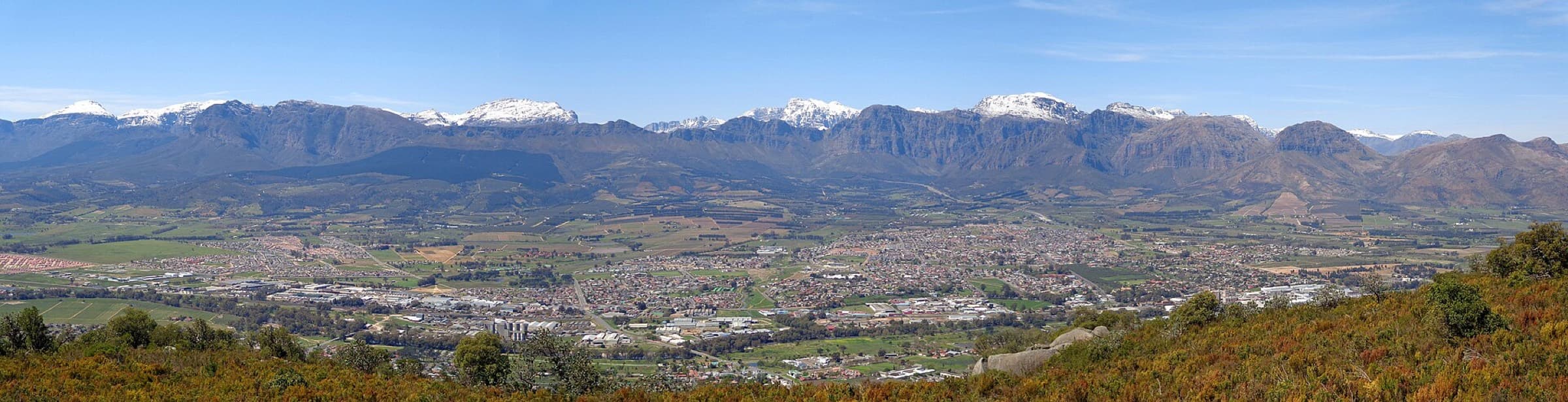
Paarl lies in the Cape Winelands about 60 km from Cape Town — under an hour by car on the N1 — on the banks of the Berg River at the foot of Paarl Mountain, a cluster of three rounded granite domes formed of roughly 500-million-year-old granite. The town takes its name from that rock: early Dutch travellers saw it glistening like a pearl after rain, and Abraham Gabbema recorded the name in 1657.
A long history
The first colonial farms in the valley were granted to free burghers by Governor Simon van der Stel in 1687, making Paarl one of the oldest towns in South Africa. French Huguenots settled area farms from 1688, a church built around 1720 anchored the growing village, and Paarl became a municipality in 1840. The Oude Pastorie of 1787 today houses the Paarl Museum.
Heritage and landmarks
- The Afrikaans Language Monument (Taal Monument) stands on the slopes of Paarl Mountain, honouring the language for which the town is a birthplace.
- The historic Main Road runs for kilometres past Georgian, Victorian, Edwardian and Cape Dutch buildings, beneath oak-lined streets.
- Drakenstein Correctional Centre, just outside town, is where Nelson Mandela spent the final months of his imprisonment.
Schools
Paarl is serious school country, which is a large part of why families put down roots here. Paarl Gimnasium was founded in 1858 and Paarl Boys' High in 1868 — among the oldest schools in the country — alongside La Rochelle and others. The annual Boys' High versus Gimnasium rugby derby draws more than 20,000 spectators to Faure Street Stadium.
Wine and lifestyle
Paarl is a gateway to the Cape Winelands, with a wine heritage stretching back to the Huguenots and estates known for Shiraz, Chenin Blanc and Pinotage. The Mediterranean climate — warm, dry summers and wet winters, with around 770 mm of rain a year — is what makes the valley both a wine region and an easy place to live.
The area today
Paarl is the largest town in the Drakenstein Local Municipality, which had a population of about 276,800 at the 2022 census. It anchors a valley that keeps drawing families and retirees from across the country — the demand that shows up so clearly in the local property market.
Own a home in this valley and wondering what it is worth? Request a free valuation.